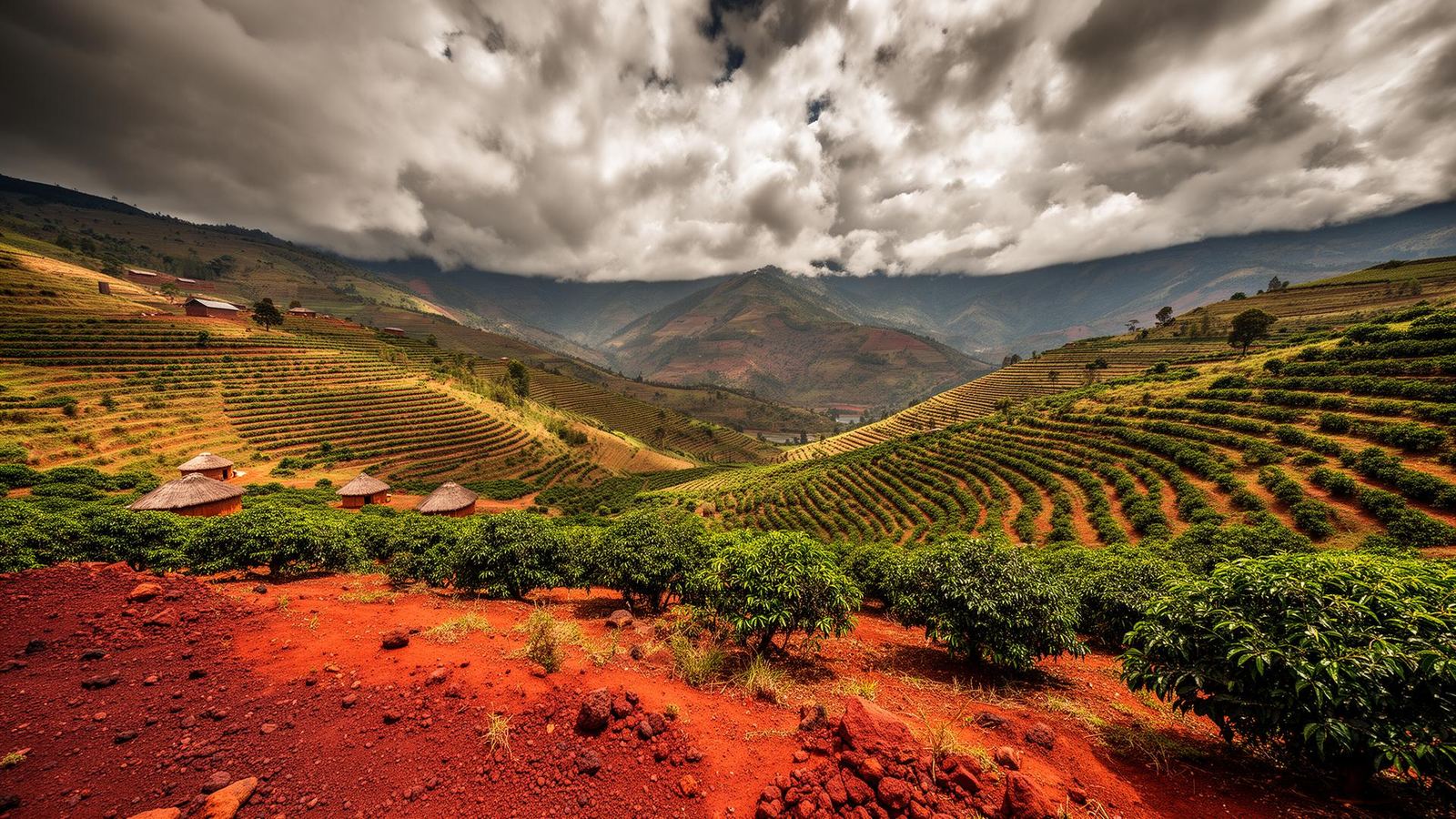
Sidamo is a coffee-growing region in southern Ethiopia's Sidama Region, producing Arabica at 1,400–2,200 m. It occupies the middle ground between Yirgacheffe's delicate florals and Guji's intense fruit: washed lots cup citrus and stone fruit, naturals deliver wine-like depth. Grade 1 Sidamo routinely scores 85+ SCA.
What Is Sidamo Coffee?
Sidamo coffee is grown in Ethiopia's southern highlands, in what is now officially the Sidama Region — one of Ethiopia's newer federal regional states, formed by referendum in 2020. It borders Yirgacheffe to the south, the Guji Zone to the east, and the Rift Valley to the west, and is Ethiopia's largest coffee-growing region by area.
Sidamo is one of three trademarked Ethiopian coffee origins alongside Harrar and Yirgacheffe — a designation reflecting its long-standing significance in international trade. Production is dominated by smallholder farmers and semi-wild agroforestry systems, with heirloom Arabica varieties grown under forest canopy across the producing districts.
Sidamo or Sidama: Which Name Is Correct?
Both names are correct in a commercial context. "Sidamo" is the historical trade name and still dominates international buyer and roaster usage. "Sidama" is the current official administrative name, used on most export documentation and grade certificates since the region's 2020 referendum. Requesting "Sidamo" from a licensed Ethiopian exporter gets you coffee from the Sidama Region — the terms refer to the same origin, and both appear on documents within a single transaction.
Terroir, Altitude, and Climate
- Altitude: 1,400–2,200 m above sea level — the broadest range of any major Ethiopian origin
- Classification: The full range qualifies as Strictly High Grown (SHG), though cup intensity varies between lots from the lower and upper ends
- Soil: Volcanic, well-drained, supporting heirloom Arabica under forest canopy
- Growing system: Smallholder garden plots and semi-wild agroforestry
The ECX divides the broader Sidamo trade zone into five geographic sub-classifications, Sidamo A through E, mapping to clusters of woredas (districts) rather than quality tiers — see Sub-Regions below.
Sidamo Flavor Profile
Washed Sidamo leads with citrus brightness, peachy stone fruit, and floral complexity, medium-to-light body, and a clean, sweet finish. Natural Sidamo deepens toward ripe cherry and wine-like texture with more structural depth and a juicy, round mouthfeel.
Washed Sidamo — typical cupping notes
- Acidity: bright, citric — orange, peach, stone fruit
- Aroma: floral, light citrus
- Body: medium to light
- Finish: clean, sweet
Natural Sidamo — typical cupping notes
- Acidity: rounded — ripe cherry, dark fruit
- Aroma: wine-like, fermented fruit
- Body: fuller, juicy, round
- Finish: long, fruit-forward
The washed profile is consistent enough across sub-zones that Sidamo has become a benchmark for accessible specialty Ethiopian washed coffee — complex but not polarising. Naturals offer fruit depth without the extreme intensity of a Guji natural. See our Yirgacheffe guide for a direct comparison point.
Processing in Sidamo
Approximately 60% of Sidamo production is washed-processed, making washed lots more consistently available across the harvest year. Natural lots from quality washing stations are produced in smaller volume and tend to be allocated earlier in the sourcing season.
For roasters building an Ethiopian program, a washed Sidamo paired with a natural Sidamo from the same district offers a controlled comparison: same origin, same altitude, different processing. See our processing methods guide for the full breakdown.
Grades and Quality Tiers
Sidamo is graded under the same ECX system as every other Ethiopian origin: physical defect counts per 300g sample, cross-referenced with an SCA cupping score.
- Grade 1: 0–3 defects per 300g, SCA 85+ — top specialty
- Grade 2: 4–12 defects, SCA 80–84 — specialty grade
One grading nuance: natural lots are graded more harshly on physical defect counts than washed lots, since dry-processing introduces more secondary defects. A well-sourced Sidamo Grade 2 natural can cup at the same level as a washed Grade 1 from the same altitude range — the grade label is not a substitute for cupping the specific lot. See the full system in our coffee grades guide.
Sidamo Harvest Window
- Oct–Jan: Cherry picking across the region
- Jan–Mar: Processing, drying, dry-milling, and grading
- Mar–Jun: Fresh-crop export; samples available for cupping
- Jul–Sep: Current-crop volumes drawn from exporter warehouses
For full-year planning, see the seasonal buying guide.
Buying Sidamo at Wholesale
- Sample first: Request 250g–1kg sample bags before committing to commercial volume
- Specify processing: Washed and natural Sidamo cup very differently — confirm method and preferred harvest year
- MOQ: One pallet (~600 kg) for mixed containers; one 20ft container (~19,200 kg) for direct trade
Submit a wholesale inquiry on our contact page for current Sidamo offer lists and FOB pricing.
Sidamo Sub-Regions and Washing Stations
The ECX groups Sidamo's producing woredas into five geographic sub-classifications (Sidamo A–E), each covering a cluster of districts rather than a quality tier. Buyers increasingly source by named woreda:
- Bensa: 1,800–2,300m, generally the most complex cups in the region; washing stations here have placed repeatedly in the Ethiopia Cup of Excellence
- Dara: Borders the Yirgacheffe zone directly; home to well-regarded washing stations including Shilcho, Bonko, and Korate
- Aleta Wondo: Lush, forested growing conditions with a hot-springs microclimate; lots tend toward floral aromatics and sweet, honey-like notes with a balanced body
- Bona Zuria: Part of the Sidamo B sub-classification alongside Arbegona
Around 200 washing stations operate across Sidama's woredas and kebeles, each offering a distinct terroir within the broader Sidamo profile.
Frequently Asked Questions
What does Sidamo coffee taste like?
Is it Sidamo or Sidama?
How does Sidamo compare to Yirgacheffe and Guji?
What percentage of Sidamo coffee is washed versus natural?
What is the minimum order for Sidamo green coffee?
GreenBean Coffee Editorial Team
Written by the export and quality control team at GreenBean Coffee, Addis Ababa. Our team has over 15 years of combined experience in Ethiopian specialty coffee sourcing, grading, and international trade logistics. All content is reviewed by licensed Q-graders and certified coffee professionals.
Last reviewed:
Ready to Source Premium Ethiopian Coffee?
Connect with our export team for samples, pricing, and availability. We ship Grade 1 & 2 Arabica to 40+ countries worldwide.